
Lowell Previous Residents by Era
The strongest source for a Lowell address changes with the period. A current Lowell parcel card begins the trail, but it does not show every person at an address. Lowell recorded land identifies ownership and legal descriptions. Lowell directory street listings add historical occupants from 1917, while earlier Lowell alphabetical volumes work from a name. Federal census records for Lowell, Lowell newspapers, Lowell maps, permits, obituaries, and cemetery material answer different parts of the same history. Treat each Lowell record as a dated view rather than a complete household list.
| Lowell historical source | Lowell period | Lowell custody route | What it can establish |
|---|---|---|---|
| Lowell Registry record books | 1855 forward in production history | Middlesex North Registry | Deeds, mortgages, liens, plans, and transfers |
| Lowell unindexed earlier books | Before 1855 | Registry counter path | Older chains through names and legal descriptions |
| Lowell directories | 1832 selected onward; street lists from 1917 | Pollard, NPS, State Library, selected scans | Names, addresses, occupations, and nearby entries |
| Federal census for Lowell | 1790-1950 | NARA and library databases | Household composition and enumeration context |
| Lowell maps, permits, and papers | Varies by collection | Pollard, city offices, Library of Congress | Building dates, address changes, and life-event leads |
For a recent Lowell transfer, begin with the Lowell assessor and the Registry. For a long-lived Lowell house, use a Lowell directory year near the address change, then match it with a released census for Lowell. Note: Every Lowell entry should retain its source year because the newest record is not always the best record for an older household.
Lowell Previous Residents Begin on the Parcel Card
Lowell’s Vision assessment database is the practical first stop for a Lowell address. The Lowell Assessor maintains ownership details for Lowell property, parcel data, sales history, and assessment records. Search a Lowell property by address or location, owner name, or map, account, or parcel reference. Capture the Lowell property location, Vision ID, account number, map ID, owner, mailing address, sales, and any legal-description or plan reference that appears on the card.
Do not convert a Lowell tax record into a household roster. The situs address of the Lowell parcel identifies the property; the Lowell mailing address shows where assessment correspondence goes. A mailing address can be outside Lowell or tied to a representative. The present Lowell card is useful because it supplies identifiers that survive when an old Lowell street number is missing from a deed or directory.
The Lowell City Assessor can verify the current card by phone or in person if an online field is unclear. Lowell GIS adds parcel, address, street-centerline, zoning, flood, district, aerial, and topography layers, but the question here remains one Lowell property over time.
Tracing Lowell Previous Residents Through Deeds
The Middlesex North Registry of Deeds offers Lowell property researchers free search, image viewing, and currently free printing or downloading. Its Lowell search menu includes Recorded Land Name, Property, Document, Book, Recorded Date, Unindexed Property, Unindexed Pre-1855 Books, and pre-1976 grantor and grantee index modes. The current owner of a Lowell parcel is ordinarily the grantee on the purchase deed; the seller on that Lowell deed becomes the next person to search as a prior grantee.
- Copy the Lowell assessor’s parcel identifiers and the present owner name, then search the Registry’s Lowell property or name record with a tight date range.
- Open the purchase deed for the Lowell parcel and record the grantor, grantee, date, book and page or document number, plan reference, legal description, and any prior-deed recital.
- Search the seller named in the Lowell deed, now acting as a grantee, in an earlier range to locate that person’s purchase.
- Repeat this Lowell title sequence while matching lot, plan, legal description, abutters, and neighboring parcels.
- When online results for the Lowell parcel end, use the older grantor-grantee indexes, unindexed books, registry terminal, or staff assistance.
- Grantor and grantee
- For a Lowell deed, the grantor transfers an interest. The grantee receives it. In a purchase deed, the seller is normally the grantor and the buyer the grantee.
- Chain of title
- The linked Lowell sequence of transfers for the same property, checked through deeds and their legal references.
- Legal description
- The lot, plan, boundary, or other property description used in Lowell recorded land. It is often more durable than an old street address.
Lowell Previous Residents Before 1855
The Registry’s record-book production history starts in 1855, but it does not mean the property story starts there. The portal exposes an Unindexed Pre-1855 Books path, and the Registry’s older grantor and grantee modes can bridge an earlier transfer. For the previous residents of a Lowell parcel, carry the most recent deed’s legal description, book and page, plan, and prior-owner recital back to the counter path. An address-only search becomes weaker as the records get older.
Registry production changed from handwritten books in 1855-1924 to typewritten books in 1924-1949, microfilm print in 1949-1995, scanned print in 1995-2001, and digital-only production after 2001 in the annual report. These are production categories, not a promise that each era has identical search fields or image depth. The Registry also provides public-terminal access to Trial Court material, which can be a useful official fallback when a related historical file is not available remotely.
Lowell’s 1859 Records Story
Lowell’s historical record includes an important continuity caution. In 1859, a courthouse fire destroyed the court-room ceiling. Historical Society material says officials carried out dockets and record books; the records were disordered during relocation but reportedly escaped fire and water damage. That is a records-handling story, not evidence that all early Lowell court material disappeared.
When an older property or family trail seems to stop, check another custody route before declaring the file lost. The Massachusetts Archives and Judicial Archives preserve some permanent court records, while later materials can move to records centers when court space is limited. A date, docket, property description, and narrow request are more useful than a broad request for every record about an address.
Lowell Previous Residents and Changing Addresses
Street names and municipal lines can break a clean-looking address search. Lowell’s Historic Board material records Hilton Street becoming Sheraton Way on August 13, 1991. City Council has authority to rename streets, so save every earlier street form rather than replacing it with today’s name. Lowell also annexed Pawtucketville in 1874 and had a Wigginville-area change in 1905. A directory or census can use a surrounding-town label for an area later treated as Lowell.
Use the street number with the lot, plan, nearby parcels, neighborhood label, and year. Historical notes mention Moody Street and later University Avenue, but the research directs readers to verify that bridge against city street files before stating it as a settled match. The historical record is strongest when the address, map, and deed point to the same place.
Past Lowell Households in Directories
Ownership is only one part of a history. Lowell directories begin in selected 1832 volumes, and street listings from 1917 allow an address-first search for recorded past residents. Selected digitized volumes include 1886, 1894, 1900, 1906, 1916, 1926, 1931, 1936, 1946, 1950, 1956, 1966, 1975, and 1985. Read the alphabetical entry, then the street section when it exists, and compare the household notes with released census records through 1950.
Pollard’s house-history method combines early directories, 1917 street listings, newspapers, Cultural Resource Inventories, Neighborhood Surveys, MACRIS, the Center for Lowell History, and GIS. The library accepts written reference requests, though the research located no fixed house-history fee or guaranteed research service. The collection details and reading conventions appear on the Lowell City Directories page.
The digitized Lowell city-directory catalog lists selected historical volumes for a year-by-year address trail.
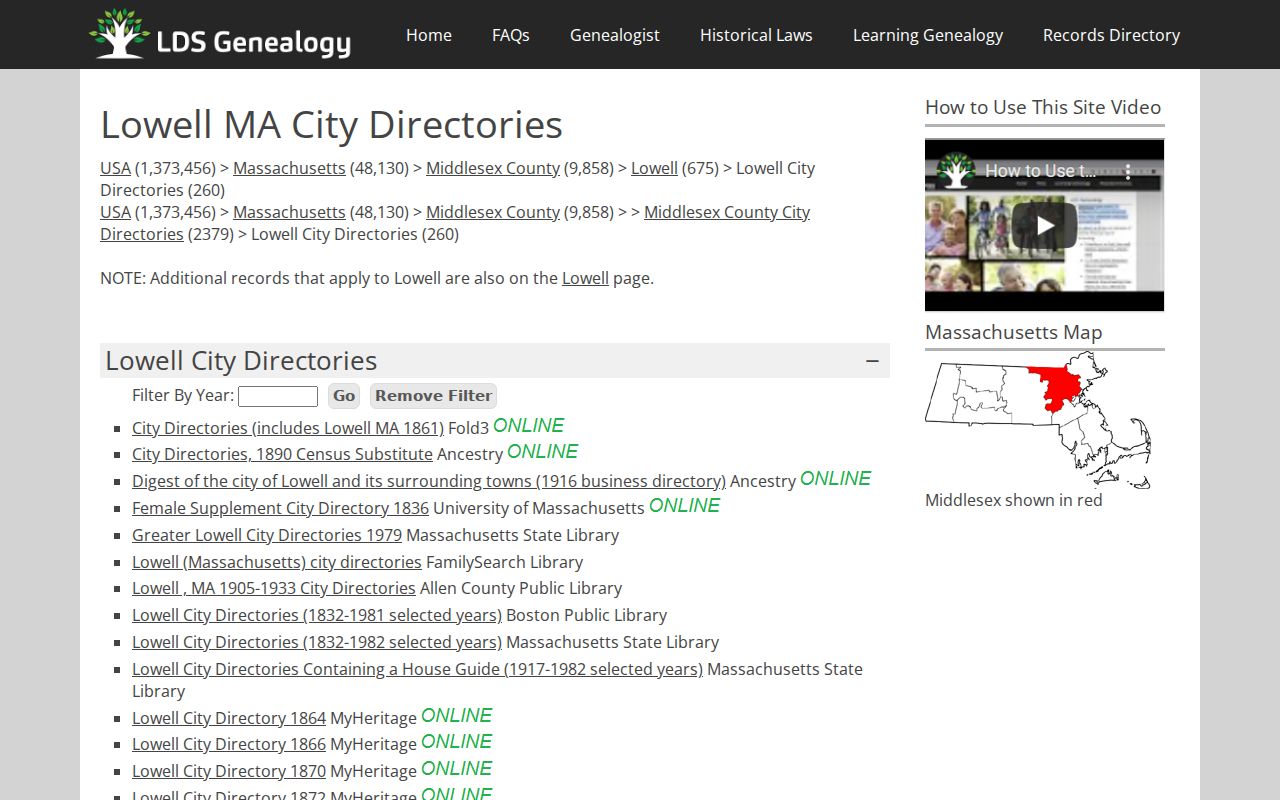
Use the catalog to choose the closest years around a move, then read the same address in the directory’s street section where that volume provides one.
Lowell Previous Residents in Maps and Permits
Maps date the building context, not a resident. Pollard and other collections hold the 1879 and 1906 city atlases, while the Library of Congress Lowell Sanborn record identifies a 1907 Volume 1 with 89 sheets and four skeleton maps. Sanborn sheets can show footprint, construction material, stories, openings, and use. Compare them with the 1896 atlas, directory years, and a deed trail to see whether the same structure was present.
Lowell Development Services can add construction or alteration evidence. Its CSS search guidance accepts address, owner, or parcel ID and recommends one field at a time, with parcel ID preferred. Current online access is limited and the city page says online permitting is unavailable; the city’s monthly application reports reach the prior two years, while older files should be requested from the office. Permit activity is evidence about a project, not proof of who lived at the address.
For the deeper local layer, the Lowell Historical Society holds Bancroft papers that combine correspondence with deeds, fire-insurance policies, foreclosure, auction, bail-bond, and poll-tax material. Its Lowell City Documents collection covers 1862-1928. The archives are at the Mogan Center, but materials are stored in several locations and should be requested ahead of an appointment. These documents can clarify a property or family connection when the deed chain and directory record leave a gap.
Closing a Lowell Previous Residents Trail
Newspapers, probate, and cemetery records can explain what happens after a name disappears from an address. Pollard has Lowell Sun microfilm from 1878, online historical newspaper access, and obituary routes. The City Cemetery Department accepts written genealogy requests that identify a lot location or family name. Its public computer includes Westlawn II and most of Westlawn I, with other coverage still incomplete. Catholic Cemetery Association listings cover 1895-2011.
For an estate clue, Middlesex Probate and Family Court North in Lowell and the Massachusetts Archives have different roles. Probate indexes are county-based, docket numbers lead to record books or file papers, and historic coverage varies. A narrow request with a name, date range, and record type gives the custodian a better basis to locate an existing file.
Note: A careful trail distinguishes an owner, a mailing contact, and a directory household instead of treating every name as the same kind of past resident.